
1. The 13 May 2027 Cliff: Why the Clock is Ticking for Indian Enterprises
Across India’s corporate boardrooms, from Tier-1 private banks and national insurers to consumer internet unicorns and hospital conglomerates, a dangerous misconception persists: "The DPDP Act was passed in 2023, the rules came in 2025, so we can take our time."
This complacency ignores the statutory reality of the transition schedule published under the DPDP Rules, 2025. The transition clock officially expires on 13 May 2027. On that morning, every organization categorized as a Data Fiduciary or Significant Data Fiduciary (SDF) in India must be capable of presenting an affirmative, unbundled, purpose-specific, and cryptographically verified consent trail for every citizen whose personal data they process.
Under Section 33(1) and Schedule 1 of the Act, failure to prevent unauthorized processing or failure to maintain affirmative consent triggers penalties up to ₹250 Crore per statutory inquiry. The Data Protection Board of India (DPBI) will not accept legacy disclaimers, implicit terms-of-service checkboxes, or fragmented departmental records as valid burden-of-proof defense.
The Core Statutory Mandate: Section 6(10) Burden of Proof
"Where a specified purpose requires the consent of the Data Principal, in any proceeding, the Data Fiduciary shall bear the burden of proving that a notice was given by the Data Fiduciary to the Data Principal and consent was given by such Data Principal to the Data Fiduciary in accordance with the provisions of this Act."
2. The "Cookie Banner Fallacy": Why Western CMPs Collapse Under DPDPA
Many Indian technology and compliance executives have attempted to solve their DPDPA obligation by purchasing off-the-shelf Western Consent Management Platforms (CMPs) like OneTrust, Cookiebot, or Usercentrics, originally designed for the European Union’s GDPR and ePrivacy Directive.
This strategy is fundamentally flawed. In Europe, CMPs primarily manage browser cookies, local storage tokens, and third-party advertising tags under the ePrivacy Directive. But India’s DPDP Act 2023 does not regulate cookies in isolation; it regulates the entirety of personal data processing across every customer touchpoint.
Consider the typical Indian enterprise customer journey:
- A customer browses a loan or credit card offer on your Web portal.
- They download your Android mobile app and complete mobile OTP verification.
- They receive account alerts, statement PDFs, and promotional upsells via WhatsApp Business.
- A tele-caller dials them via an outbound IVR/call center dialer to offer insurance products.
- They walk into a physical retail bank branch or hospital check-in counter to submit paper or tablet KYC documents.
- They swipe their card at a point-of-sale (POS) terminal or digital payment gateway.
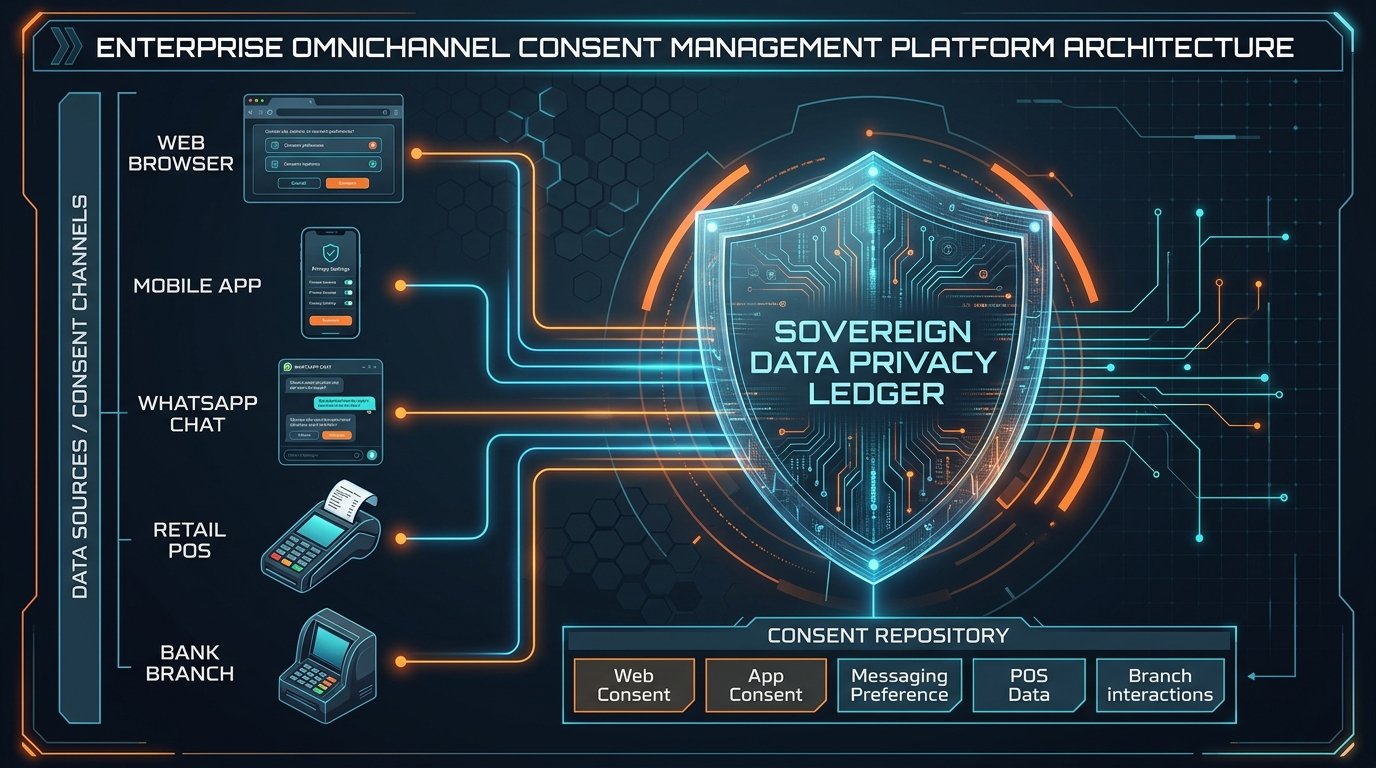
If your Consent Management Platform only lives as a JavaScript banner on your desktop website, you have only secured approximately 5% of your enterprise personal data exposure. When that customer later withdraws consent for marketing on WhatsApp, but your IVR dialer calls them the next day, you have committed an explicit Section 6(5) violation.
3. Mapping Every Customer Touchpoint Under Section 6
A compliant enterprise CMP must orchestrate consent across six foundational channels. Each channel has distinct technical realities, interaction constraints, and statutory requirements:
Zero-Tracker Static Gating
Under Section 6(1), marketing, analytics, and session recorders (Meta Pixel, Google Ads, Hotjar, MoEngage) cannot deposit cookies or dispatch telemetry prior to explicit opt-in.
Android & iOS SDK Gating
Mobile operating system permissions (Location, Contacts, SMS) are NOT statutory consent under DPDPA. App SDKs must quarantine user identifier generation until affirmative consent tokenization.
Conversational Bot Opt-Ins
Enterprise WhatsApp messages cannot be broadcast based on implied numbers. Interactive consent cards with quick-replies must capture purpose-specific approval before transaction alerts or upsells.
DTMF Tone & Voice Hashing
Outbound marketing calls require verifiable consent evidence. Interactive Voice Response (IVR) DTMF keypresses ("Press 1 to consent") must generate real-time tokens synced to the enterprise dialer.
Paperless QR & OTP Handoff
Physical bank branches, retail checkout POS counters, and insurance agent forms require frictionless digital handoffs. Cashier screen QR codes or SMS OTP consent capture bridge offline to online.
Real-Time View Gating
Support agents using Salesforce, Freshworks, Zoho, or LeadSquared cannot browse unmasked citizen records unless valid consent or Section 7 statutory processing grounds exist.
4. Technical Architecture: How an Omnichannel Sovereign CMP Works
To orchestrate consent across web, apps, messaging, voice, and offline counters, the engineering architecture requires four core technical layers:
A. The Centralized Immutable Consent Ledger
Consent cannot be stored as a simple mutable boolean column (marketing_consent = 1) in a transactional SQL table. Under Section 6(10), you must prove what exact notice version the user saw, the exact language it was displayed in, the timestamp, their IP or phone identity, and the exact purposes checked.
B. Real-Time Kafka / Webhook Propagation
When consent is granted or withdrawn, that event must propagate downstream within milliseconds. If a citizen unchecks "Loan Marketing" on the website, an event must immediately dispatch to Kafka / AWS EventBridge topics:
- MarTech Platforms (MoEngage, CleverTap, Netcore): Suppress user from active marketing campaigns instantly.
- Enterprise CRM (Salesforce, LeadSquared): Update lead consent status flag in real-time.
- Outbound Telephony Dialers: Blacklist phone number from automated dialing queues.
- Third-Party Processors: Issue real-time cessation webhooks to external agency vendors under Section 8(2).
C. The Section 6(5) "Equal Ease" Withdrawal Mandate
One of the sharpest enforcement teeth in DPDPA 2023 is Section 6(5): "The Data Principal shall have the right to withdraw her consent at any time, with the ease of doing so being comparable to the ease with which such consent was given."
If giving consent took 1 tap on a web banner or 1 button press on WhatsApp, forcing the user to send an email to a privacy officer or navigate 6 menus in a mobile app to revoke consent is an automatic statutory violation. An omnichannel CMP must expose unified self-service preference portals accessible via web link, WhatsApp command (REVOKE), or SMS keyword.
D. Section 9 Verifiable Parental Consent (VPC)
For EdTech, gaming, e-commerce, and social applications processing data of minors under 18, Section 9 bans behavioral tracking, targeted advertising, and processing that causes detrimental effects on children. An omnichannel CMP must orchestrate multi-step guardian verification (DigiLocker KYC, Aadhaar OTP, or guardian token linkage) before onboarding minor accounts.
5. Comparative Matrix: Web Cookie Banner vs. Sovereign Omnichannel CMP
| Compliance Dimension | Legacy Web-Only Cookie Banner | Sovereign Omnichannel DPDPA CMP |
|---|---|---|
| Channel Coverage | Desktop & Mobile Web only (5% of data flows) | Web, iOS/Android SDKs, WhatsApp, IVR, POS, Branches |
| DPDPA Section 6 Alignment | Fails. Designed for GDPR ePrivacy cookie consent | Native purpose-specific processing gating under Section 6(1) |
| Language Support | English only or manual localized translations | Dynamic multi-lingual engine in 22 Eighth Schedule languages |
| Withdrawal Propagation | Client-side cookie deletion only; zero backend sync | Real-time Kafka/Webhook sync across MarTech, CRM, and dialers |
| Burden of Proof Audit | Unsigned analytics logs easily challenged at DPBI | Immutable SHA-256 signed tamper-evident ledger tokens |
| Data Residency | Stored in US/EU multi-tenant cloud servers | 100% Indian Sovereign Infrastructure (CERT-In compliant) |
| Statutory Penalty Exposure | High (Up to ₹250 Crore under Section 33) | Audit-ready immunity and demonstrable Section 6(10) defense |
Why Indian Enterprise CISOs Are Replacing OneTrust & Cookiebot with Kavach Sovereign CMP
Leading Indian financial institutions, high-volume B2C applications, and healthcare networks are migrating away from legacy Western CMP providers for five critical operational reasons:
- Zero USD FX Volatility & Transparent INR Pricing: Avoid expensive annual dollar license escalations and unpredictable pageview tier penalty surcharges.
- 100% Sovereign Data Residency: Fully deployed inside Indian data centers (MeitY empaneled & CERT-In compliant), preventing cross-border transfer violations.
- True Omnichannel Capability: Native SDKs for Flutter, React Native, iOS, Android, and bi-directional Meta WhatsApp Business Webhooks—not just a web banner.
- Turnkey 22 Scheduled Languages: Dynamic automated translation and statutory validation across Hindi, Tamil, Telugu, Bengali, Marathi, Gujarati, and all Eighth Schedule languages.
- Sub-Second Downstream Suppression: Pre-built event connectors for Kafka, AWS EventBridge, Salesforce, MoEngage, CleverTap, and Vicidial telephony.
6. The 18-Month Engineering & Procurement Roadmap (Countdown to 13 May 2027)
Deploying an enterprise omnichannel CMP is not an overnight software installation. It requires architectural modifications to identity managers, data lakes, customer facing channels, and vendor agreements. Here is the recommended CISO/CTO execution roadmap:
Catalog every point of citizen personal data capture. Run deep headless network scans (using tools like the Kavach Pre-Consent Scanner) to identify shadow trackers firing before affirmative consent. Audit third-party SDKs in mobile app builds.
Deploy the sovereign consent ledger on Indian cloud infrastructure. Draft purpose-itemized statutory notices compliant with Section 5. Translate and verify notices across primary Eighth Schedule languages relevant to your regional customer base.
Embed SDK gates in Android and iOS apps. Connect WhatsApp Business Webhooks to the consent API. Integrate IVR DTMF tone capture with telecom switches. Implement QR/OTP paperless handoffs at physical retail and banking counters.
Conduct simulated DPBI burden-of-proof mock audits. Verify that sub-second consent withdrawal reliably halts downstream ad campaigns, automated dialers, and data sharing with contracted processors. Obtain Board certification prior to statutory go-live.
Frequently Asked Questions: Omnichannel CMP & 13 May 2027 Deadline
Prepare Your Enterprise for 13 May 2027 with Kavach CMP
Kavach Privacy provides India's premier sovereign, multi-lingual, and omnichannel Consent Management Platform designed from the ground up for the Digital Personal Data Protection Act, 2023 and DPDP Rules, 2025.